Why a Garden Path Changes What You Notice
See how a garden path directs attention, and learn to assess its turns, views, and stopping places by walking the route in different conditions.
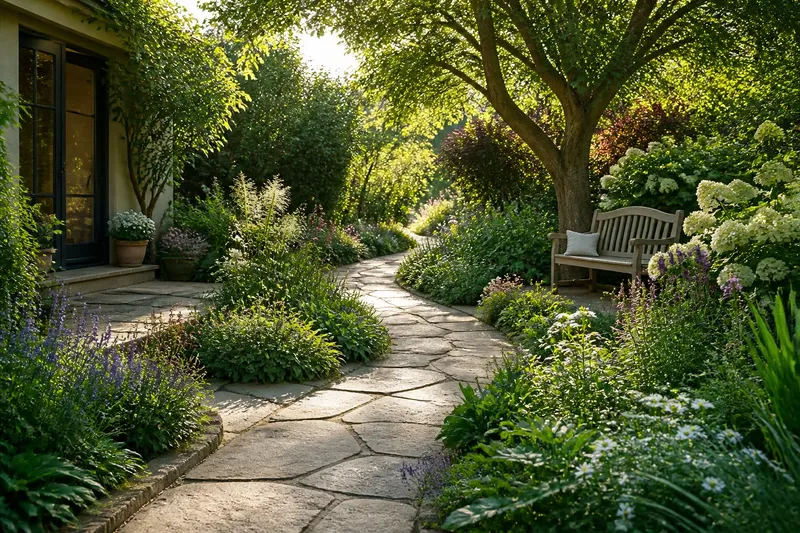
A garden path changes what you notice by controlling where you look, how quickly you move, and what comes into view next. A straight route can make a destination feel immediate; a gentle bend can let a tree, bench, or cluster of flowers appear in stages. To assess your own route, walk it from both ends and pause at the places where your gaze naturally lands.
Start with the route’s purpose
Before judging a path’s shape, decide what it needs to do. A route between a back door and a shed has a different job from a leisurely circuit through a planted garden. The first should make its destination easy to find. The second can invite slower movement and changing views.
Try finishing this sentence: “When someone enters this path, I want them to notice…” Your answer might be the old apple tree, a sunny seat, the pond, or simply the doorway at the far end. That choice gives you a practical way to evaluate the route: does its direction help a visitor notice that feature, or distract from it?
Think of a path like a flashlight beam. It does not create the things around it, but its direction influences what gets attention first. A path need not point directly at every focal feature. It can lead the eye toward a view, frame it between planting, or hold it back until the walker reaches a particular turn.
Choose by garden situation
The right route depends on how people use the space and what you want the walk to feel like. These situations can help you choose a direction without treating a curve or straight line as automatically better.
- If the destination must be obvious: Choose a direct route, especially between a frequently used door, gate, or work area. A clear line helps visitors orient themselves and avoids making an everyday trip feel like a search.
- If there is one feature worth revealing: Use a bend or offset that delays the view until the walker reaches a useful point. This fits a garden where a seat, sculpture, or flowering shrub is more appealing when seen from a particular angle.
- If people need to see across the garden: Keep the sightline open from the path, or use a mild curve rather than a sharp turn. This suits a compact garden where awareness of the whole space matters more than surprise.
- If the route passes several areas: Let the path shift direction near a real change in use, such as moving from a patio toward a quieter planting area. The turn can mark that transition without needing a sign or decorative feature.
- If the path feels exposed: Consider a route that passes beside planting or screens an unappealing view, while keeping the way ahead legible. This can suit an overlooked boundary or a utility area, provided the screening does not make the route confusing.
These choices are about attention, not a fixed style. A straight path can still reveal a feature gradually if planting partly frames the view. A winding route can still feel direct if each turn offers a clear next destination.
Read the sightlines
Stand at the path’s entrance and look along it at a relaxed, walking height. Notice the first strong feature your eyes settle on. Then ask what you see behind it and what seems to pull your gaze away. A bright gate, bare wall, or open patch of sky may claim attention before the garden feature you hoped to emphasize.
Repeat the same check at turns, entrances to side areas, and places where the path widens. These points often shape the experience more than the middle of a long stretch. At a bend, look for a clear clue about where to go next: a visible continuation, a distinctive tree, or a glimpse of the destination.
Check sightlines from both directions. A route that feels inviting from the house may appear to end abruptly when approached from the far side. If a view depends on seeing a feature behind you, consider whether visitors will naturally turn around or whether that view needs to be visible from the other direction too.
Walk it in changing conditions
One walk can make a route seem better or worse than it is. Walk it at different times of day, in ordinary weather, and when the garden looks less full. The aim is not to inspect every possible condition, but to learn whether the path’s sequence of views still makes sense when light and foliage change.
On a sunny visit, note where glare makes you look down or where a bright opening draws your eyes away from the route. On a cloudy day, check whether the intended focal point still stands out. When leaves are sparse, see whether a screen that once hid a service area now leaves it in full view.
Walk at your usual pace, then walk more slowly. At each natural pause, ask what made you stop: a view, a change in direction, a tight passage, or uncertainty about where the route goes. A pause can be part of a pleasant sequence, but hesitation caused by a hidden continuation is a sign that the route needs clearer visual cues.
Make a simple route check
Use a short note on your phone or a sketch of the path. For each important point, record what is visible, what draws your attention, and whether you know where to go next. Keep the notes specific: “bench appears after the bend” is more useful than “nice view.”
- Begin at the main entrance and name the first feature you notice.
- Walk to each turn and check whether the next section is visually clear.
- Pause where the route meets a seat, doorway, or garden room and note what the path frames.
- Turn around at the destination and repeat the walk back.
- Visit when foliage or light differs and note which views change most.
- Mark any place where you slow down because the route is unclear rather than because the view invites a pause.
Say you have a path from a kitchen door to a small bench, but a tall shrub hides the bench until you are almost beside it. Imagine moving the route’s gentle turn so the bench becomes visible earlier, while the shrub still softens the view from the patio. On a later walk, the observable result to look for is whether the bench reads as a destination sooner and the path still feels easy to follow.
Questions about path views?
Should a garden path be straight or curved?
Choose a straight route when clear, direct access matters most. A curve can suit a leisurely route or help control when a feature comes into view, but it should still show enough of the way ahead to feel understandable.
How can I make a path feel less exposed?
Look for a route that passes beside planting or turns away from an unwanted view without hiding its continuation. Check the effect from both directions so a sheltered feeling does not become a confusing dead end.
Where should a path lead the eye?
Let it guide attention toward a feature that matters from the walking route, such as a seat, tree, or garden entrance. If the path points at a less appealing view, adjust its direction or use the planting around it to frame a better one.
When should I reassess the route?
Walk it after a noticeable change in foliage or light, and whenever you add or remove a feature that blocks a view. A quick walk in the opposite direction can also reveal a sightline that the usual approach hides.
Let the walk decide
Use what you notice while walking to guide changes, rather than reshaping a path simply because a particular curve seems attractive on paper. If the way ahead is clear and the important views arrive in a satisfying order, the route may already be doing its work. If one point repeatedly steals attention or leaves you unsure, focus a small adjustment there and walk the path again.