Upright or Spreading Plants for a Narrow Border?
Upright or spreading plants for a narrow border: compare their visual footprints and choose forms that leave room for paths, windows, and neighboring plants.
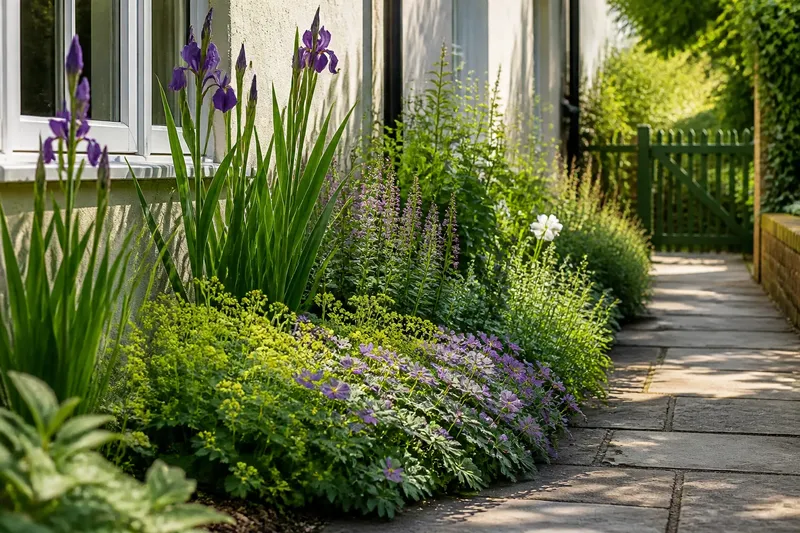
In a narrow border, plant shape matters as much as plant size. Upright or spreading plants for a narrow border can occupy the same patch of soil yet make the space feel entirely different: one draws the eye upward, while the other reaches across the ground. Judge the outline you will see, not just the label on a pot.
Read the border in profile
Stand where you usually see the planting: at a kitchen window, beside a path, or from the garden gate. A border that looks slim from above may feel generous at eye level, while leaves that lean into the walkway can make it seem pinched. Notice what needs to remain visible and clear, including a window, a gate latch, or the edge of a neighboring bed.
Then look at the border from the side. Upright plants concentrate their visual mass into vertical lines. Spreading plants create a lower, broader outline, often extending over the soil between their stems. The ground they occupy and the space their leaves appear to occupy are not the same thing.
Think of each plant as an umbrella: its stem is narrow, but its canopy claims room around it. The umbrella may be held close to the body or opened wide. That visible canopy, especially where it meets the path or overlaps another plant, is the practical footprint to consider.
Choose an upright outline
Upright forms suit a border where the main constraint is side-to-side room, but some height is welcome. Their clear vertical lines can mark an entrance, frame a view, or give a long, low planting a point of emphasis. A narrow row of upright leaves can also let the eye travel along the bed instead of stopping at a broad mound.
Look for the plant’s whole habit, not only a tall flower spike. Check whether its leaves rise close to the stems or arch out near the ground. A plant that looks narrow at the nursery may still spread at its base, where it can crowd a path edge or neighboring foliage.
Upright planting is a good fit if you want a defined edge, a visible backdrop, or a slim accent beside a wall or fence. It may be less suitable if the border is overlooked from above and you want the soil covered, or if tall forms would block a view you value. A line of repeated vertical shapes can also feel rigid, so consider interrupting it with a change in leaf height or spacing.
Choose a spreading outline
Spreading forms suit a border where you want a soft, connected surface rather than a series of distinct stems. Their foliage can visually join gaps and blur a hard edge. Low, outward-growing leaves may also make a planting feel fuller without adding a tall screen.
That softness comes with a sideways claim. Leaves may lean over a path, cover small plants, or conceal the border’s edge. In a particularly tight strip, even a low mound can make the usable walkway feel narrower. Think about where the foliage will sit at its broadest, not only where the stems emerge.
A spreading form is often a better fit when the bed has a little breathing room beside it and the aim is a continuous, relaxed outline. It is less suited to a border that must stay sharply within a narrow edge or keep every small plant visible. If you like both effects, use spreading foliage where it can soften an open corner and keep the most constrained stretch more vertical.
Combine forms with intention
A mix can create depth, but it needs a clear order. Let upright plants carry the main line, then place a modest spreading form where it can soften a gap without spilling into a route. Reversing that relationship—a broad foreground shape with an occasional upright accent—makes the border read as a low sweep punctuated by vertical marks.
Keep the number of competing outlines modest. Several upright plants with different leaf widths may still read as one rhythm; too many broad mounds, by contrast, can merge into an unbroken mass. Repeat a shape where you want continuity and introduce a different one where you want the eye to pause.
Say you have a narrow bed below a kitchen window, with a path directly in front. You want a clear view out and enough room to pass, but the soil looks bare between plants. You could place upright forms toward the window and choose one low spreader at the bed’s open end; the expected visual result is a taller line that keeps the central path edge legible, with a softer finish where space opens up.
Questions about plant shape?
How can I judge a plant’s visual footprint?
Look at the full outline of its leaves and stems, including any arching or outward reach, rather than relying on the size of its container. Compare that outline with the path edge and nearby plants from the viewpoint you use most.
Can spreading plants work beside a path?
They can if the border has enough room for their foliage to remain within its intended edge. Where the path is already tight, choose a more contained outline or reserve the spreading form for a section away from foot traffic.
Do upright plants always take less room?
No. A tall plant can still carry broad leaves or arch out near the ground, so height alone does not describe its footprint. Check whether its width is concentrated at the top, the base, or both.
Can one border use both forms?
Yes, if each form has a distinct job and the combined outline still leaves the route and focal views clear. Use upright shapes to establish a line and spreading ones to soften selected openings, rather than mixing them without a visual order.
Make the choice by outline
Before choosing plants, sketch the border as a simple side view and mark what must remain open: the path, a window view, or a neighboring planting. Add narrow vertical marks for upright forms and low arcs for spreading ones. The sketch will not predict every leaf, but it can expose a crowded edge before you buy.
Choose upright forms when height and a restrained side-to-side outline serve the space; choose spreading forms when a low, connected edge matters more and there is room for it to reach. For a narrow border, that distinction is more useful than choosing by height alone. The best plant shape is the one whose visible footprint supports how you move through and look across the garden.