A Late-Autumn Garden Visit, Focused on Structure
A late-autumn garden visit can reveal the shapes and spatial relationships that summer foliage hides, helping you read a garden beyond its color.
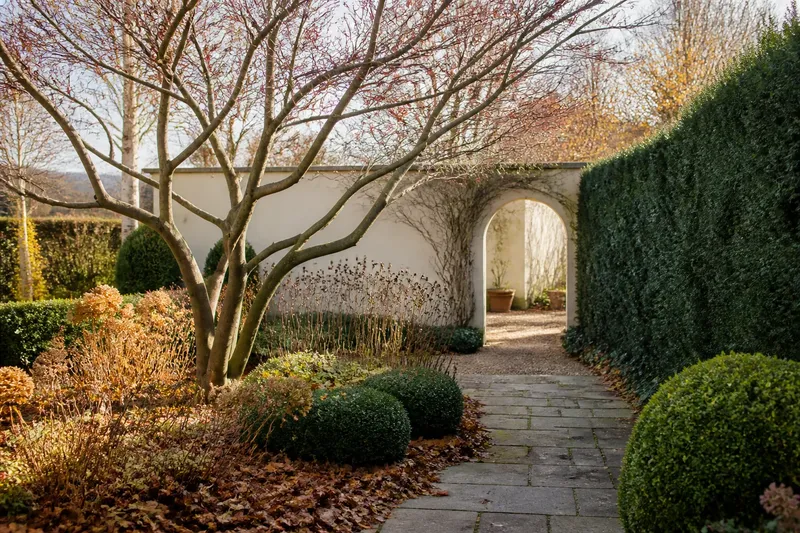
A late-autumn garden visit reveals structure that summer foliage can hide. With many leaves down and flowers gone, the eye can follow trunks, branching lines, open gaps, and the way one planted area meets another. Walk slowly, and the garden starts to read less like a display of color and more like a composition of shapes.
Begin at the entrance
Pause just inside the gate or at the usual point of arrival. Notice what catches your eye first: a tree canopy, a clipped evergreen, a pale wall, or an opening toward the far end. Bare branches make this first impression easier to trace because they no longer merge with a mass of foliage.
Look at the outline of the view rather than naming every plant. Does a tall form frame the scene, or does it block the destination? Is there a low band of grasses or shrubs that leads the gaze onward? These relationships remain part of the garden through the quiet season, even when their summer colors are absent.
If the entrance view feels flat, shift your position slightly and look again. A small change in viewpoint may reveal that a branch overlaps a roofline or that two shrubs form a narrow window onto a deeper space. This is an observation, not a verdict: the overlap may be intentional, or it may simply become noticeable when leaves drop.
Read the bare outlines
Choose one deciduous shrub or tree and follow its main branches from base to tip. Notice whether the branches rise, arch, spread sideways, or divide into a loose fan. The overall silhouette often matters more than the fine twigs. A vase-shaped shrub, for example, leaves a different kind of open space beneath it than a dense, rounded one.
Compare a bare plant with a nearby evergreen. The evergreen gives the view a steady mass; the deciduous plant exposes lines and gaps. Together they can make a border feel layered rather than uniformly full. If both forms have similar outlines, the composition may feel quiet and cohesive. If they differ sharply, the contrast can give the eye a clear point of interest.
Look down as well as up. Old stems, seed heads, and fallen leaves can soften the boundary between plant and ground. Leave them in place for the moment of observation, unless they are blocking access or creating another practical concern. Their outline may show how a planting carries its form through the season, even after its flowers have disappeared.
Notice the open spaces
Late autumn makes empty space visible. Look between a tree’s lower branches, across a gap between beds, and through the opening beneath an arch or pergola. These spaces help explain how the garden feels: a clear gap can offer visual rest, while a partially screened opening can suggest somewhere beyond.
Pay attention to the ground plane in these openings. A lawn, a patch of leaf litter, a paved terrace, and a strip of dark soil each read differently beneath bare branches. The surface is not the main subject of this visit; it is a background that can make a silhouette stand out or fade. A pale trunk against a dark evergreen hedge, for instance, is easier to pick out than the same trunk against a light wall.
Try a simple comparison from the same spot: first look at the solid forms, then look at the spaces around them. It is a little like reading the gaps between words on a page; the blank areas help define the shapes that remain. This shift can reveal whether a border has breathing room or whether its plants overlap into one continuous mass.
Follow the vertical lines
Find the strongest upright forms in the view. They might be tree trunks, a row of stems, a gatepost, or the narrow edge of a wall. Then notice what crosses or counters them: a low hedge, a horizontal branch, a bench, or a run of fencing. The meeting of vertical and horizontal lines gives a garden a quiet rhythm, especially when flowers no longer distract the eye.
Check whether the tallest forms are spaced evenly or grouped. Regular spacing can make an avenue or boundary feel ordered; a loose cluster can feel more natural and enclosed. Neither arrangement is automatically better. The useful question is whether the spacing suits the experience of that part of the garden: open, sheltered, formal, or gently irregular.
Look for a change in scale as well. A small shrub near a large tree can make the tree feel more imposing, while a taller plant behind a low border creates a gradual rise. In late autumn, these shifts often show up as clean outlines. Make a note of the relationship, not just the plant name, so you can remember what the form contributes.
Seasonal structure questions?
What should I look for after leaves fall?
Start with the outline of trees and shrubs, then notice the gaps between them and the ground beneath. Those features show how the garden is organized when foliage no longer fills the view.
Which plants keep their shape in late autumn?
Evergreens, clipped shrubs, ornamental grasses, and plants with sturdy stems can retain visible form, though their appearance varies by variety and local conditions. Compare their outlines in place rather than assuming one group will always provide the clearest structure.
Should I cut back every faded plant?
Not necessarily; some stems and seed heads can contribute visible texture and shape through the quiet season. Follow plant labels and manufacturer instructions where relevant, and check local rules when they apply; for a plant-specific decision, a qualified horticulture professional can help.
How can I remember what I noticed?
Write down the viewing spot and a few relationships, such as “dark hedge behind pale trunks” or “open gap beneath the arch.” A quick sketch with simple lines can preserve the arrangement more clearly than a list of plant names alone.
Make a short field note
Say you arrive at a small courtyard where a crabapple has dropped its leaves and a yew hedge remains dense. You notice the tree’s forked branches against the hedge, plus an opening beneath the lowest limbs that frames a pale wall. In your notebook, record those two observations and the spot where you stood. The expected result is a usable reminder of the courtyard’s winter outline, rather than a vague note that it looked bare.
Keep the visit focused. Choose one view, one plant outline, and one open space to study before moving on. If a feature changes your sense of the garden, note what it is: a line that leads toward a door, a gap that makes a corner feel deeper, or a dense shape that anchors the edge.
A late-autumn garden visit can also help you decide what to observe again later, without turning the walk into an immediate redesign plan. Return to the same viewpoint when new growth appears and see which relationships remain visible. The clearest field note may be a simple one: which shapes hold the scene together after its color has faded.