The Knot Garden and Its Patterned Past
A knot garden turns interlacing lines into a legible view. Learn how its historic design logic can shape a small, orderly garden today.
A knot garden makes interlacing lines legible from a chosen viewpoint. Its patterned past is not just a story of clipped hedges and tidy symmetry: the design asks the eye to follow one strand, lose it beneath another, then pick it up again. That small visual puzzle can organize a garden even when the planting is modest.
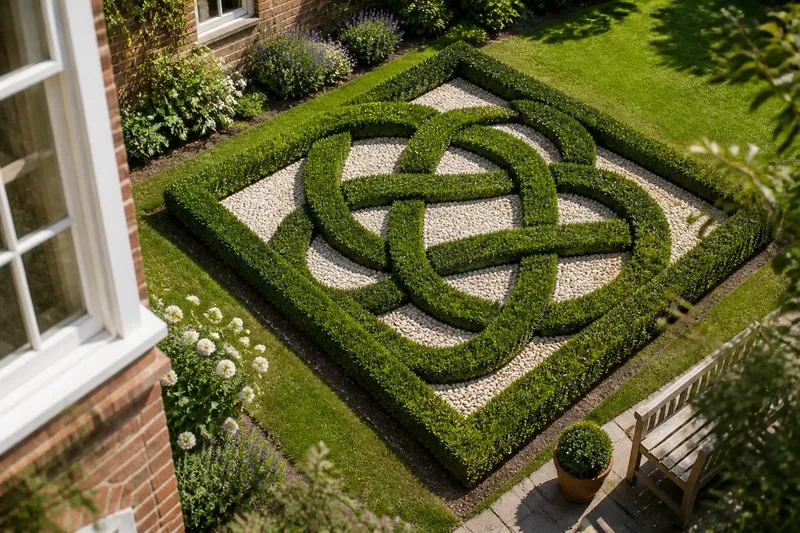
To see how the idea works in practice, imagine a clearly hypothetical project: a gardener has a square patch beside a brick house, viewed mostly from a kitchen window. The gardener wants a formal focal point, but not a miniature maze or a collection of fussy ornaments. The following walk-through shows how a knot pattern can be read, adapted and kept visually clear.
A Pattern with a Past
The knot garden belongs to a long tradition of formal garden design in which geometry made order visible. Interlacing bands, repeated turns and balanced compartments offered a deliberate contrast to less controlled growth nearby. The pattern was meant to be read from above or from a raised position, where its crossings and repeated motifs could be seen as a whole.
Historically, the effect could be made with clipped plants, low borders, colored materials, or a combination of these. The important feature was not one particular species or surface, but the relationship between lines: a continuous band appeared to pass over and under another. A knot pattern therefore works like a woven ribbon laid flat. The eye reads continuity even where the line seems to disappear.
That distinction matters in a home garden. A design need not imitate a particular historic layout to borrow its visual logic. It can use a restrained, simplified pattern and still create the sense of interlacing. The goal is not to reproduce an old garden in miniature; it is to make a view feel composed through repeated turns and clear crossings.
Reading the View
In the imagined project, the gardener begins at the kitchen window rather than at the planting bed. From there, the square patch appears as a single panel. A knot pattern is most convincing when the viewer can recognize its overall shape before noticing the smaller details, so the gardener avoids a design that depends on walking around it to understand what is happening.
The first decision is to give the design a calm outline. A square border contains the pattern and separates it from the surrounding lawn. Inside that boundary, two broad looping bands cross in a balanced arrangement. The turns are generous enough to remain readable from indoors; tight curls would collapse into visual clutter at that distance.
Next, the gardener considers the crossings. If every strand appears to pass over every other strand in the same way, the design can look like a flat diagram rather than a woven form. Alternating the apparent over-and-under sequence gives the eye a route to follow. The band itself stays continuous, while the interruption at a crossing is conveyed by a small gap or a shift in edging.
On paper, this is easier to judge than in a bed. The gardener sketches the square, draws the bands as broad ribbons, then traces each one with a finger. If a strand seems to stop without reappearing, the crossing needs clarification. If the eye cannot tell which band passes over, the design needs a cleaner break or a simpler route.
Choosing the Bands
For the hypothetical garden, the gardener chooses low boxwood-like edging plants for the raised visual line, with a contrasting infill between the bands. The exact plant choice is not the pattern itself. Its purpose is to make the line read as a line, while the open or differently colored spaces keep neighboring strands distinct.
A knot garden can also use clipped herbs, low-growing foliage, gravel, brick fragments, or other materials suited to the site. Each choice changes the character of the design. A clipped plant edge gives a soft, living outline. A mineral infill can make the negative space appear crisp. A mix can work, but too many textures compete with the crossings.
The gardener in this example chooses a restrained palette: one green edging, one pale infill, and the darker soil or ground visible beyond the square. This allows the pattern to do the talking. If every band has a different color, the viewer may read separate compartments rather than interlacing lines.
Plant form also affects legibility. A low, compact edge keeps the motif in view. A plant that leans into the infill can blur the distinction between strand and gap, while a taller plant can hide a crossing from the principal viewpoint. The gardener considers the mature form and maintenance needs before settling on a species; plant labels and local growing conditions should guide that choice.
Making the Hypothetical
Say the gardener has drawn a pattern that looks balanced on paper but appears crowded from the kitchen. The action is not to add more detail. Instead, the gardener widens the spaces between the looping bands and removes one small interior curl. The expected observable result is a clearer silhouette, with fewer places where the strands visually merge.
The design is then marked on the ground with string and temporary stakes. The gardener checks it from the window, from the garden entrance and from the edge of the bed. The window remains the main view, but the other positions reveal whether the pattern has an awkward side or an unclear turn. The layout is adjusted while it is still only a set of temporary lines.
At a crossing, the gardener leaves a visible change in the infill to suggest which band passes over. The bands remain the same width, and the corners use a consistent curve. These repeated decisions create a rhythm. A knot garden often feels coherent not because every detail is elaborate, but because the same visual rules recur.
After planting, the gardener keeps the surrounding area simple. A plain lawn edge and an uncluttered background help the central motif stand out. A bench or pot can still be nearby, but placing several strong shapes directly beside the square would compete with the pattern. The garden is treated as a framed view, not a display shelf.
What Changes with Seasons?
A knot garden is a living drawing, so its appearance shifts as plants grow, are clipped, or lose foliage. That movement is part of the design rather than a flaw. The gardener’s task is to keep the underlying route visible, not to force every season to look identical.
In the hypothetical project, the green edging becomes fuller through the growing season. The gardener watches for places where foliage closes the gaps at crossings, because those are the points where the woven reading can disappear first. Light pruning keeps the strands distinct. In colder months, the evergreen outline may remain legible while the infill changes color or texture.
Seasonal change can also reveal whether the pattern relies too heavily on flowers. A brief display may brighten the interior, but blossoms should not be the only cue that separates one band from another. The gardener uses persistent differences in height, texture or material so the structure remains understandable when flowering ends.
This is where a knot garden differs from a pattern that is merely decorative at one moment. Its design is built around relationships that can survive variation: the outline, the crossing sequence and the repeated turns. Seasonal details add interest, while the geometry keeps the view organized.
Questions About Knot Gardens?
Does a knot garden need clipped hedges?
No. Clipped plants are one familiar way to draw the bands, but low herbs, contrasting ground materials, or a combination can also define the pattern. Choose elements that keep the crossing lines distinct from the chosen viewing position.
Can a small garden hold a knot pattern?
Yes, if the design is simplified to suit the available view and space. Broad, readable loops usually communicate more clearly than many tiny turns packed together.
How can the over-and-under effect read?
Keep the strands visually continuous and make each crossing unambiguous with a consistent shift in edging or infill. A sketch traced by hand can reveal a broken route before the layout is marked outdoors.
What is the difference between a knot garden and a maze?
A knot garden is primarily a pattern to view, while a maze is arranged as a route to walk and solve. The knot’s interlacing can suggest movement to the eye without creating passages for visitors.
Lessons from the Design
In the imagined case, the finished view is not the result of adding historical decoration. It comes from making a few decisions consistent: a clear boundary, broad looping strands, distinct crossings and a limited material palette. The gardener has used an old formal idea to give a small patch a strong visual center without asking it to function as a maze.
For anyone considering a knot garden, the most useful first question is where the pattern will be read from. A design seen from an upper window can be more intricate than one viewed at ground level. Once that viewpoint is clear, sketch the outline, trace every strand, and simplify any crossing that seems uncertain.
The knot garden’s patterned past offers a practical lesson for present-day design: a view can feel richly organized when a few lines relate clearly to one another. In the hypothetical square beside the brick house, the gardener’s final useful decision is to leave a little visual breathing room around the motif. That quiet margin lets the interlacing remain the subject, even as the plants change through the seasons.